Twelve Months, Twelve Moods: The Americans Who Dress Their Lives in Scent
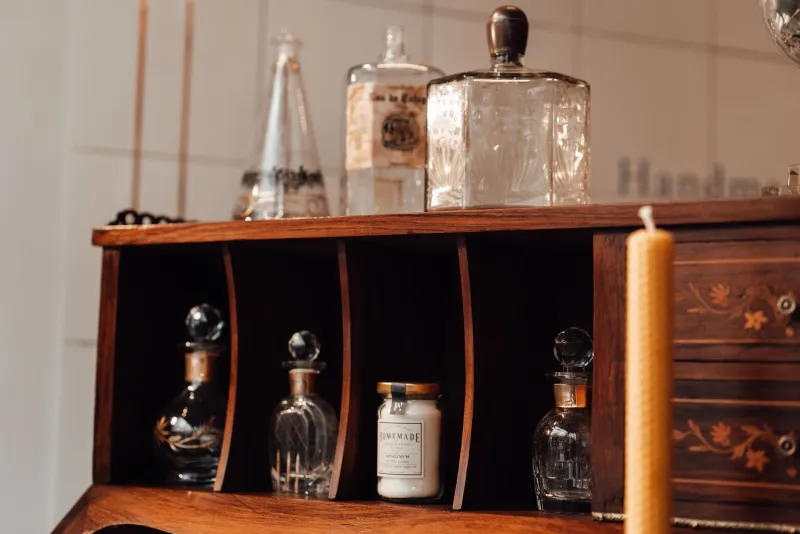
Somewhere in a Brooklyn apartment, Marisol Vega has a shelf that looks less like a perfume collection and more like a timeline. There's the thick, resinous amber she wears every November — something she associates with her grandmother's kitchen and the particular heaviness of late autumn. There's the sharp, green vetiver she reaches for in early spring when the city starts to smell like wet pavement and possibility again. And tucked at the end, a small bottle of something oceanic and bright that only comes out in the dead of August, when she needs to trick herself into feeling like she's somewhere near water.
"I don't think of it as collecting," Marisol says, swirling a sample vial between her fingers. "I think of it as dressing my year."
She's not alone. Across the country, a quietly passionate group of fragrance enthusiasts — not necessarily industry insiders or luxury obsessives, just people who've started paying attention — are building what some are calling personal fragrance calendars. The concept is simple: instead of committing to one signature scent, you curate different fragrances for different seasons, moods, or moments in life. The practice is something else entirely: a form of intentional self-expression that treats smell as a dynamic, living part of identity.
Beyond the Signature Scent
For decades, the beauty industry sold us a particular fantasy — find your scent, own it, become it. The signature perfume was supposed to be the olfactory equivalent of a monogram. Timeless. Unchanging. Yours.
But culture shifts. And so, apparently, do noses.
"The idea that you should smell the same at 22 as you do at 45, or that you should smell the same in January as you do in July, is kind of strange when you think about it," says perfumer and scent educator Dana Holloway, who runs workshops out of Portland, Oregon, teaching people how to build what she calls a "fragrance wardrobe." "We change our clothes with the seasons. We change our playlists. We change the way we decorate for the holidays. Scent is just another layer of that."
Holloway started noticing the shift a few years ago, when clients began coming to her not asking for help finding the scent, but asking how to curate a rotation. "People were treating fragrance the way they treat music or food — seasonally, intentionally, with real thought behind it."
What the Brain Actually Does With Smell
There's a neurological reason why seasonal scent-switching feels so resonant. Smell is the only sense with a direct line to the limbic system — the part of the brain that handles memory and emotion. It bypasses the rational brain almost entirely, which is why a single whiff of something can collapse time in a way that a photograph rarely can.
Dr. Priya Nair, a cognitive psychologist based in Chicago who studies sensory experience and identity, explains that smell is uniquely tied to what researchers call "autobiographical memory" — the deeply personal, emotionally loaded memories that form the backbone of how we understand ourselves.
"When you intentionally pair a scent with a season or a life chapter, you're essentially bookmarking your own story," Dr. Nair says. "You're creating a sensory anchor. And when you return to that scent — even years later — it can pull you back to that version of yourself with extraordinary clarity."
This is exactly what many fragrance calendar devotees describe. For Marcus Chen, a 34-year-old graphic designer in Austin, the practice started almost accidentally. He'd worn a particular cedar and smoke fragrance during a solo road trip through New Mexico five years ago, and when he came across it again at a department store sample counter, the memory hit so hard he had to sit down.
"It was like being teleported," he says. "And that's when I thought — what if I did this on purpose? What if I chose a scent for this next year, this next chapter, and let it become the smell of that time?"
Now Marcus keeps what he calls a "scent journal" — a small notebook where he logs which fragrance he's wearing, what's happening in his life, and how the two feel in conversation. It sounds obsessive until he shows you the entries, which read less like product reviews and more like compressed diary pages.
Curating the Year
The practice looks different for everyone. Some people divide their fragrance calendar strictly by season — something warm and spiced for fall and winter, something lighter and botanical for spring, something aquatic or citrus-forward for summer. Others organize by emotional register: a "focused work" scent, a "social" scent, a "Sunday morning" scent.
Lena Park, a 29-year-old teacher in Atlanta, approaches it through life chapters rather than calendar months. "I wore a specific jasmine fragrance through my whole first year of teaching," she says. "It's done now — I retired it. But if I smell it anywhere, I'm immediately back in that classroom, that version of myself who was terrified and excited and figuring everything out. It's like I preserved that year in a bottle."
This kind of intentional archiving is part of what makes the practice feel like more than a beauty trend. It's closer to what artists and writers have always done — finding the material that captures a moment before it slips away.
The Market Responds (Sort Of)
The fragrance industry has been slow to catch up with this shift in how consumers actually relate to scent. Most marketing still leans on the aspirational signature — the one bottle, the one identity, the loyalty play. But smaller, indie perfume houses have been quicker to read the room.
Brands like DS & Durga, Maison Louis Marie, and a growing number of Etsy-based independent perfumers have built devoted followings among the fragrance calendar crowd, partly because their collections feel more like a library than a lineup. "They make things that feel like they belong to specific moments," Marisol says. "Not to a type of person, but to a time of year, a kind of light, a feeling."
Holloway sees the indie fragrance boom as inseparable from this broader shift toward intentional living. "People are pushing back against the idea that consumption should be passive," she says. "Building a fragrance calendar is a creative act. It requires you to actually think about how you want to move through time."
Smell Your Way Through the Year
If you've never thought about fragrance this way, the entry point is simpler than you might expect. It doesn't require spending a fortune on rare perfumes or developing a connoisseur's vocabulary. It starts with paying attention — noticing which smells make you feel most like yourself in different seasons, and leaning into that rather than away from it.
Maybe it's the pine resin candle you burn every December that already functions as a seasonal anchor. Maybe it's the sunscreen smell of summer that you've been treating as accidental rather than intentional. The fragrance calendar crowd would say: nothing has to be accidental.
For Marcus, the practice has become less about the scents themselves and more about the quality of attention they require. "You have to actually think about what this chapter of your life feels like," he says. "What it smells like. That's not nothing. That's a kind of self-knowledge most people skip right over."
And Marisol, replacing the November amber back on her shelf, puts it even more simply: "Every year has a smell. I just decided to choose mine."