Dog-Eared and Deliberate: The Americans Falling Back in Love With Reading Slowly
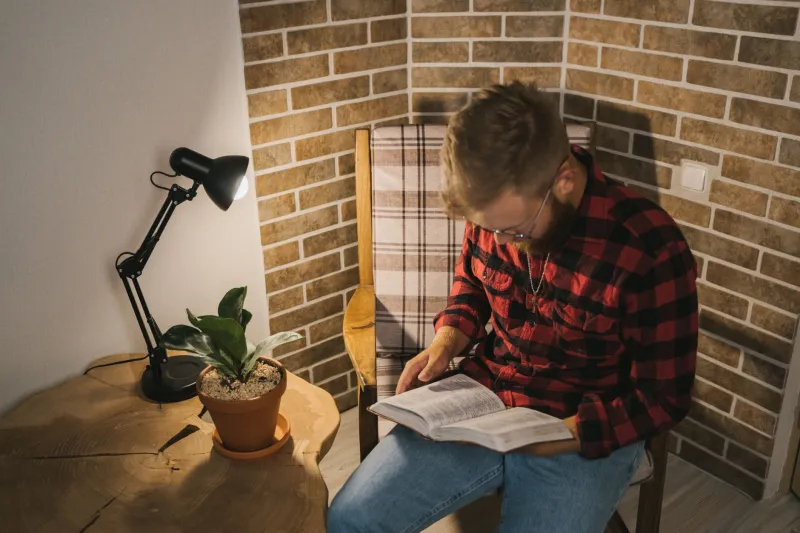
Somewhere between the fifth productivity podcast and the third app promising to triple your reading speed, Maya Okonkwo hit a wall. She had "read" 47 books the year before — skimmed them, really, the way you scroll a feed — and remembered almost none of them. "I could tell you the title and the vibe," she says, laughing from her apartment in Portland, Oregon, where a reading chair sits wedged between a floor lamp and a window that overlooks a magnolia tree. "But the actual words? Gone. Like I'd eaten a whole meal and still felt hungry."
So she stopped racing. She picked up one book — a worn paperback copy of Marilynne Robinson's Gilead — and decided she wouldn't move on until it felt finished in her bones, not just on her shelf. That was eight months ago. She's still thinking about it.
Maya isn't alone. Across the country, a quiet but meaningful shift is happening in how Americans relate to books — not as content to consume, but as objects worth sitting with. Call it slow reading. Call it intentional reading. Whatever the name, the practice is drawing people back to something that felt lost: the idea that a book can be a relationship, not a transaction.
The Problem With the Reading List
The Goodreads annual challenge — where users set a numerical goal for books completed each year — has been a cultural fixture for over a decade. And while it's gotten millions of people reading again, it's also quietly turned something contemplative into something competitive. When the goal is quantity, quality tends to blur.
Reading coaches and librarians have been noticing the fatigue. "People come in feeling guilty that they didn't finish their challenge, or they feel hollow because they did," says Dara Simmons, a community librarian in Nashville who started hosting slow reading circles at her branch two years ago. "They've optimized all the joy out of it."
Her reading circles work differently. Participants choose one book per month — sometimes one per season — and meet not to summarize it, but to sit inside it together. They talk about sentences. They argue about a single paragraph. They bring their annotated copies and read their margin notes aloud like dispatches from a private life.
"It's the most alive I've seen people in a library in years," she says.
Margins as a Second Language
One of the most visible expressions of the slow reading movement is the return of marginalia — those handwritten notes, underlines, and little stars readers leave in the margins of their books. For a generation that grew up highlighting PDFs and reading on Kindles, writing directly in a physical book can feel almost transgressive. For slow readers, it's become essential.
Jordan Tillman, a graphic designer based in Austin, Texas, started annotating his books during the pandemic and never stopped. His shelves are full of paperbacks that look like they've been through a conversation — ink in three different colors, tiny drawings in the margins, dates written next to passages that hit differently depending on when in his life he encountered them.
"The book changes every time I read it," he says. "My notes from when I was 24 are embarrassing in the best way. They tell me who I was."
For Jordan, the physical book has become something closer to a journal than a product. He doesn't lend them out — not because he's precious about ownership, but because the annotations are too personal. "It's like giving someone your diary," he explains. "The book is mine now. We've been through something together."
This kind of book journaling — keeping a separate notebook where readers record reactions, questions, and quotes as they move through a text — is also gaining traction. Bullet journal communities on social media have spawned entire sub-niches dedicated to "reading logs" and "book spreads," where the act of documenting a reading experience becomes its own creative output.
Building the Nook
Slow reading has a spatial dimension too. You can't really do it on a commute, half-listening to a podcast, phone face-up on the coffee table. It asks for a place.
The reading nook — that cozy, dedicated corner carved out of a bedroom or a living room — has become something of a sanctuary for this community. Not just a chair and a lamp, but a considered environment: soft lighting, a candle, a blanket that only comes out for reading, a small shelf holding only the books currently in rotation.
Chloe Reyes, an interior design enthusiast in Chicago, spent three weekends turning a former storage alcove in her apartment into what she calls her "reading room" — though it's barely big enough to hold two people. A cushioned window seat, built-in shelves painted a deep forest green, a single pendant light. She reads there every morning before work, for 30 minutes, with her phone in another room.
"It's the only part of my day that's completely mine," she says. "Nothing is optimized in that corner. Nothing is efficient. It's just me and whatever world I'm living in that week."
For Chloe, the nook isn't décor — it's infrastructure. It signals to her brain that something different is happening here. Something slower.
Reading as Ritual, Not Resume
What's striking about the slow reading movement is how consciously its practitioners have rejected the language of self-improvement. They're not trying to become smarter or more productive readers. They're trying to become more present ones.
"I don't care if I read five books this year," Maya says. "I care if I actually lived inside them."
There's something almost countercultural about that in a moment when every hobby has been gamified, every interest tracked and quantified. Reading slowly — deliberately, annotatively, nook-bound — is a small act of resistance. It says: this is not content. This is culture. And culture deserves time.
Dara Simmons sees it as part of a bigger hunger. "People are exhausted by the pace of everything," she says. "A book that you sit with, that you argue with, that you write in — it becomes a record of your inner life. That's not nothing. That's actually everything."
Maybe the real reading challenge isn't how many books you can finish. Maybe it's how fully you can enter one.