Press Play on Yourself: The Americans Turning Playlists Into a Portrait
There's a particular kind of intimacy in handing someone a playlist. Not a shared queue, not a "you might also like" suggestion generated by a server farm somewhere outside Phoenix — but a real, deliberate sequence of songs that someone sat with, moved around, second-guessed, and finally committed to. It says: this is how I hear the world, and I want you to hear it too.
For a lot of Americans, that act has quietly become one of the most meaningful creative gestures in their lives.
The Algorithm Gave Us Everything Except a Point of View
Streaming was supposed to solve music. And in some ways, it did — you can find almost anything, instantly, for the price of a couple of coffees a month. But somewhere in that abundance, something got lost. When the platform knows what you want before you ask, the experience of choosing starts to atrophy. Playlists built by Spotify's editorial team or shaped by listening data are fine. They're just not yours.
That gap is exactly what a growing community of sonic curators is pushing back against. They're not anti-streaming — they're using the same platforms, the same apps, sometimes even the same songs. What's different is the intention behind the arrangement.
"I think of it like editing," says Marcus, a 29-year-old graphic designer in Atlanta who spends a few hours each month building what he calls "situation playlists" — collections tied not to a mood but to a specific feeling he's trying to articulate. "There's a difference between a song being good and a song being right at that moment in the sequence. That's the whole thing for me."
Sequence Is the Statement
Ask anyone who takes playlist-making seriously and they'll tell you: the order matters more than the songs. It's the same logic that governs a great album, a well-paced film, a compelling short story. You're not just picking tracks — you're building an arc.
Some people open with something disarming, a familiar sound that lowers the listener's guard before pulling them somewhere unexpected. Others bury the emotional gut-punch in the middle, letting the playlist breathe back out toward something quieter. There are playlist-makers who treat the closing track the way a novelist treats the final sentence — as the thing the whole thing was building toward.
Jade, a librarian in Portland, Oregon, has been making playlists for friends as birthday gifts for the better part of a decade. She keeps a notes app full of song ideas sorted by person — fragments she files away when something reminds her of someone. "When their birthday comes around, I already have half the material," she says. "The work is in figuring out what story I'm trying to tell about them. That's what takes time."
The result, she says, is something people hold onto. "I've had friends tell me they still listen to a playlist I made them four or five years ago. That doesn't happen with a gift card."
The Mixtape Is Back (It Never Really Left)
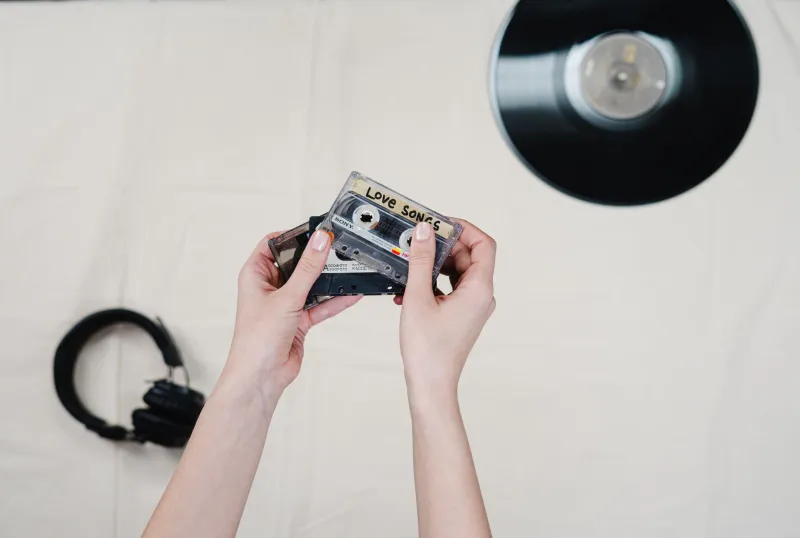
For a certain generation, this impulse has a name: the mixtape. And while cassettes are largely a nostalgia object now, the spirit of the form has not only survived but evolved. Some people are reviving the physical ritual entirely — recording songs onto actual tapes, printing custom J-cards, mailing them across the country to people they love. Others are creating digital playlists with the same painstaking care, complete with handwritten track listings slipped into birthday cards or texted as screenshots alongside a streaming link.
There's even a small but enthusiastic corner of the internet devoted to the art of the playlist as aesthetic object — cover art, sequencing notes, liner-note-style descriptions of why each track made the cut. Reddit threads, Discord servers, and Substack newsletters have sprung up around the practice. People share playlists the way they once passed zines around a record store.
What's interesting is who's doing it. It's not just people in their 40s chasing a Gen X memory. Younger listeners — people who grew up with streaming as their default — are increasingly drawn to the intentionality of the form. They didn't have mixtapes, but they understand the impulse. In a world of infinite content, the act of limiting yourself, of saying "these 14 songs and no others," feels almost radical.
Sound as Self-Portrait
At its core, this is about identity. What you listen to has always said something about who you are, but what you curate says something more. It requires a point of view. It requires you to make choices and stand behind them.
"A playlist is a self-portrait," says Dani, a music teacher in Chicago who started sharing themed playlists on a small blog after getting frustrated with algorithmic recommendations. "You're not just saying 'I like this song.' You're saying 'I like this song here, in this context, next to that song, because of the way they talk to each other.' That's a perspective. That's a voice."
The themes people build around vary wildly — playlists for specific times of day, for seasons, for emotional states too granular to have names, for road trips on specific highways, for the feeling of being almost-but-not-quite over someone. The specificity is the point. The more precise the concept, the more it functions as genuine creative expression.
Some people make playlists they never share at all. Private collections that function more like journals than gifts — a running record of where they were emotionally at a given moment, preserved in song order.
The Gift of Being Heard
But perhaps the most powerful use of the form is still the one that started with cassette tapes in the '80s: making something for someone else. A playlist built for another person requires you to hold their interiority in your mind — to think about what they love, what they need, what they haven't heard yet but will immediately recognize as theirs. It's an act of attention. And attention, as anyone who has felt truly seen by another person knows, is one of the rarest gifts going.
In an era when so much of our cultural consumption is mediated by platforms optimizing for engagement, there's something quietly subversive about two people exchanging a handmade sonic document. No data was collected. No engagement metric was served. It's just one human saying to another: I listened, and then I made you something.
Press play. The story starts now.