Throw Out the Recipe: How Home Cooks Are Turning the Kitchen Into a Creative Studio
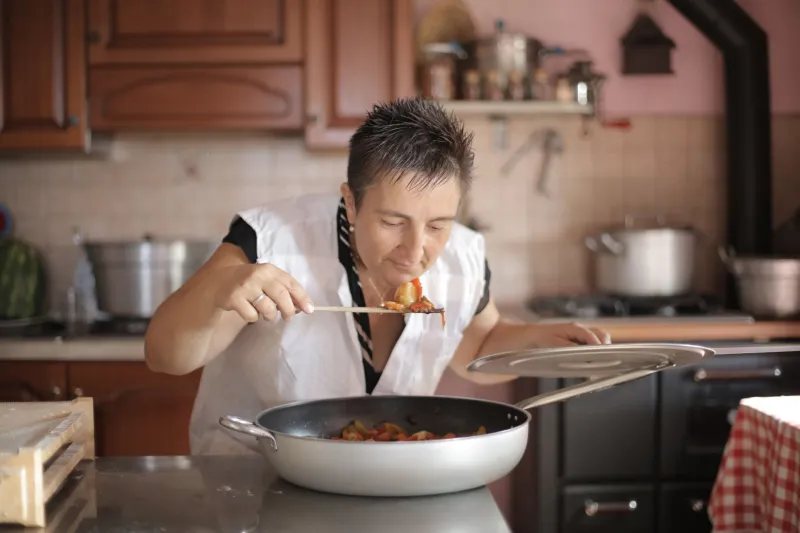
Somewhere between the seventh food influencer video and the fourteenth step in a viral recipe thread, Marcus Delgado — a graphic designer from Tucson, Arizona — closed his laptop, walked into his kitchen, and just started cooking. No recipe. No app. No perfectly portioned mise en place. Just a cast iron pan, some leftover roasted vegetables, and a block of feta he'd been meaning to use.
"I honestly don't even remember what I made," he says, laughing. "But I remember that it was mine. And that it was good."
That small act of culinary rebellion turned into something bigger. Two years later, Marcus cooks almost entirely from intuition — tasting as he goes, riffing on flavors he remembers from his grandmother's kitchen in Albuquerque, building dishes that don't have names and couldn't be Googled. He's part of a quiet but growing movement of home cooks who are stepping away from the algorithmic food machine and reclaiming the kitchen as a space of genuine creative expression.
The Recipe Industrial Complex
We live in the golden age of food content. There are more recipes online than any human could cook in ten lifetimes. Apps like Yummly and Whisk promise to organize your entire culinary existence. TikTok serves up a new trending dish every seventy-two hours. And yet, for a certain kind of home cook, all of this abundance has started to feel like a trap.
"Recipes flatten cooking into a task," says Priya Nair, a teacher from Atlanta who describes herself as a "recovering recipe follower." "You're not learning to cook — you're learning to execute someone else's vision. And when it doesn't come out exactly right, you feel like you failed, not the recipe."
Priya started cooking improvisationally after spending a weekend at her aunt's house in Chennai during a family visit. Her aunt, she says, had never once consulted a cookbook. She cooked by smell, by texture, by the way oil moved in a pan. "She could tell a dal was ready by the sound it made. That completely broke my brain. I came home and thought — what if I tried to cook like that?"
What followed was, by her own admission, several months of genuinely bad food. Oversalted soups. Underseasoned grains. A particularly regrettable experiment involving tahini and canned tomatoes. But somewhere in that messy process, something shifted. She started understanding why certain flavors worked together, not just that they did.
Cooking as a Sensory Practice
This is the thing that separates intuitive cooking from simply winging it: it's not about chaos. It's about developing a deep, embodied literacy with ingredients, heat, and flavor. Practitioners talk about it the way artists talk about learning to draw — you have to understand the fundamentals before you can break them.
Jordan Whitfield, a musician and home cook from Portland, Oregon, draws the comparison directly. "Learning an instrument, you start with scales. You don't just pick up a guitar and play jazz. But once you have those fundamentals in your body, the best thing you can do is put the sheet music away."
For Jordan, that foundation came from years of cooking with his mother — a lot of Southern staples, a lot of watching and absorbing. Now his cooking is a kind of improvised jazz in its own right: built on structure, but always moving somewhere unexpected. He recently made a dish he describes as "a riff on dirty rice" that incorporated miso, smoked paprika, and a handful of fresh herbs from his fire escape garden. There's no version of that dish online. It exists only in his memory and, briefly, on his dinner table.
"That's the whole point," he says. "It's ephemeral. It's mine."
Memory as the Original Recipe
Again and again, the cooks who've made this shift point to the same source material: memory. Not Pinterest boards or saved Instagram posts, but the sensory archive of meals eaten, kitchens observed, smells that have never quite left them.
For Marcus, it's the chile-forward heat of his grandmother's red posole. For Priya, it's the particular tang of tamarind in a dish she ate at a roadside stall in Madurai at age nine. For Jordan, it's the way his mother's kitchen smelled on Sunday mornings — butter, coffee, something sweet in the oven.
This kind of cooking is, in its way, a form of cultural preservation and personal storytelling. It's how food traditions have always been passed down — not through written instructions, but through presence, repetition, and the slow accumulation of taste memory. The recipe was always a shortcut. An approximation. The real thing lived in the hands and the nose and the gut.
"I think we forgot that," says Priya. "We started treating cooking like software. Like if you just input the right variables, you get the right output. But cooking isn't software. It's alive."
The Rejection of Optimization
There's a broader cultural current running through all of this — one that Ineriva has been tracking across creative communities from zine makers to letter writers to analog photographers. In a moment when so much of daily life has been optimized, quantified, and filtered through an algorithm, there's a real hunger for practices that resist that logic. Cooking, it turns out, is a particularly rich site for that resistance.
Food apps and recipe platforms are, at their core, optimization tools. They promise efficiency, consistency, reproducibility. And there's nothing wrong with any of that — sometimes you just need dinner on the table by six. But when optimization becomes the only mode, something gets lost. The mess. The surprise. The dish that turned out better than it had any right to, because you trusted your instincts and got lucky in exactly the right way.
The intuitive cooks interviewed for this piece aren't anti-technology, and they're not food snobs. Most of them still look things up occasionally. A few still use apps for grocery lists. What they've rejected isn't convenience — it's the idea that cooking should be reduced to a set of instructions to be followed correctly.
"I don't want to be graded," Marcus says. "I want to create."
Starting Your Own Experiment
If any of this resonates, the good news is that the entry point is lower than you might think. Most of the cooks in this space suggest starting not with a blank slate, but with something familiar — a dish you know well, made from a recipe you've cooked a dozen times. Then, one night, make it without looking at the recipe. See what you remember. See what you reach for.
From there, start substituting. Out of one ingredient? Don't run to the store — see what else is in the cabinet. Too spicy? What's in the fridge that might cool it down? Too flat? What would add depth?
The mistakes are part of it. The burned edges and the too-salty broths are data, not failures. Over time, they add up to something you couldn't have learned from any app: a culinary intuition that's entirely, irreducibly yours.
The kitchen, it turns out, has always been a studio. Some of us are just remembering that now.