Bottled Memories: The Americans Blending Their Own Perfumes to Tell the Stories No One Else Can
There's a particular smell that lives in Marisol Vega's memory — her grandmother's kitchen in San Antonio on a Sunday morning. Warm masa, dried chiles hanging near the window, something sweet and smoky underneath it all. For years, that scent existed only in her head, surfacing at odd moments the way sensory memories do: suddenly, fully, and then gone.
So she decided to build it herself.
"I spent about three months sourcing ingredients, reading about fragrance families, watching YouTube videos at midnight," says Vega, a graphic designer who now runs a small-batch perfume side project out of her Austin apartment. "When I finally got something close — not exact, but close — I actually cried. It felt like I'd pulled something out of my own mind and made it real."
Vega is part of a quietly expanding movement reshaping how Americans think about fragrance. Across the country, people are stepping away from the sanitized uniformity of mass-market perfumes and leaning into something far more intimate: the art of making scent from scratch, as a form of personal expression, cultural memory, and creative storytelling.
Beyond the Department Store Counter
For most of its modern history, fragrance has been sold to us as aspiration. Buy this bottle and become someone. The marketing is slick, the bottles are gorgeous, and the scents themselves are engineered to appeal to the broadest possible audience — which, almost by definition, means they can't be deeply personal to anyone.
The indie perfumery scene has been pushing back against that for years. Small fragrance houses like Imaginary Authors in Portland, Commodity out of New York, and Black Phoenix Alchemy Lab in Los Angeles built loyal followings by leaning into narrative and weirdness, releasing scents named after obscure novels or emotional states rather than celebrity lifestyles. But the newer wave goes even further — it skips the brand entirely and puts the blending directly in the hands of the person wearing it.
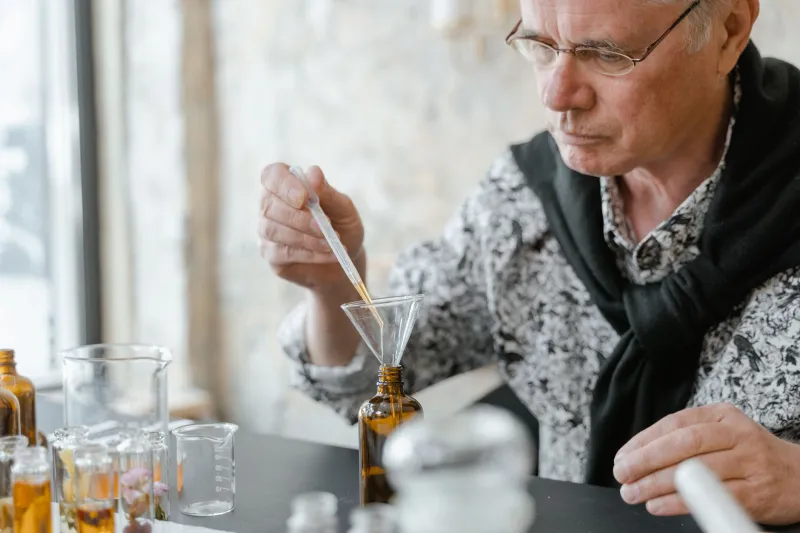
Workshops are popping up in cities from Chicago to Seattle to Atlanta where participants learn the basics of fragrance construction: top notes, heart notes, base notes, the way certain molecules behave over time on warm skin. Platforms like Etsy and Faire are full of indie makers selling their own blends in small amber bottles with handwritten labels. Online communities on Reddit and Discord trade sourcing tips, review aromatic materials, and share formulas with the same nerdy enthusiasm that homebrewers bring to craft beer.
The entry point is genuinely accessible. A starter kit of fragrance-grade essential oils and aroma chemicals from suppliers like Perfumer's Apprentice or Tisserand can run as little as $50 to $100. From there, it's experimentation — and, for many people, something closer to excavation.
Smell Is the Most Honest Sense
The science here is worth pausing on. Olfaction is the only sense with a direct neural pathway to the limbic system, the part of the brain that processes emotion and long-term memory. It's why a whiff of sunscreen can teleport you to a childhood beach vacation before you've consciously registered what you're smelling. No other sense works quite this fast or this deep.
For the people crafting their own fragrances, that neurological quirk isn't incidental — it's the whole point.
Derrick Osei, a Brooklyn-based musician and self-taught perfumer, has been building a fragrance archive of his life for the past four years. Each blend corresponds to a specific period or place: the apartment he lived in during his early twenties, a summer road trip through the South, the specific smell of the recording studio where he made his first album. He doesn't sell them. They're entirely for himself.
"It's like keeping a journal, except you can actually experience it again," he says. "Reading old diary entries feels kind of distant. But when I open one of these bottles, I'm back there. It's a different kind of remembering."
Others are using fragrance to explore identity in a more outward-facing way. Queer and trans creators have found particular resonance in scent-making as a space free from the gendered marketing that dominates mainstream perfumery. When you make your own blend, there's no "for him" or "for her" on the label — there's just what smells right to you, on your body, in your life.
The Culture Is Catching Up
The broader culture is starting to notice. Fragrance content has exploded on TikTok and YouTube, with creators building massive audiences around blind tests, ingredient deep-dives, and fragrance layering tutorials. The hashtag #PerfumeTok has racked up billions of views. Glossier, known for its minimalist aesthetic and cult following, has leaned further into fragrance. Even major fashion houses are responding to consumer demand for more transparency about what's actually in their bottles.
But the homemade, hyper-personal end of the spectrum feels distinct from all of that. It's less about consumption and more about authorship. The people blending their own scents aren't trying to find the perfect product — they're trying to make something that couldn't exist without them specifically.
Workshops like those run by The Smell Festival (a traveling fragrance arts event that's made stops in New York, LA, and New Orleans) often end with participants describing their creations in almost literary terms: this smells like a specific argument I had with my mother, this smells like the version of myself I want to become, this smells like the city I grew up in before it changed.
That language matters. It signals that for a lot of people, fragrance has graduated from accessory to medium.
Craft, Community, and the Invisible Art
What makes the custom fragrance movement feel genuinely alive right now — rather than just niche — is the community infrastructure that's grown up around it. Online forums share knowledge freely. Indie suppliers cater specifically to hobbyists and small makers. Swap communities let people trade samples across the country, building connections around shared olfactory taste the way music fans once traded mixtapes.
There's also something quietly radical about centering an art form that's invisible, that leaves no object behind, that exists only in the moment of experience. In a culture obsessed with documentation and the visual, fragrance resists the feed. You can't really photograph a smell. You can't screenshot it. You just have to be there.
Marisol Vega is still refining her grandmother's kitchen blend. She's gotten closer, she says, though she suspects she'll never get it exactly right — partly because the memory itself keeps shifting, the way memories do.
"But that's kind of beautiful, actually," she says. "It's a living thing. Every time I adjust the formula, I'm also figuring out what I actually remember, what I'm holding onto, what matters. It's not just perfume at that point. It's more like therapy, honestly."
Bottled memories. Personal mythology you can wear on your skin. If culture is how we make meaning together, then scent — intimate, invisible, and entirely your own — might be one of the most honest ways we have left to tell the truth about who we are.