No Recipe Required: The Americans Cooking Their Way Back to Grandma's Kitchen
The last time Denise Okafor tasted her grandmother's jollof rice, she was eleven years old, standing in a Lagos kitchen that smelled of tomato paste and woodsmoke. Her grandmother died the following year. The recipe died with her — or so Denise assumed. Twenty-three years later, living in Atlanta and missing something she couldn't quite name, she started cooking from memory.
"The first version was terrible," she laughs. "But I kept going because I could still remember what it was supposed to feel like. Not just the taste — the texture, the warmth of it. My body knew what I was aiming for even when my hands didn't."
Denise isn't alone. Quietly, in home kitchens from Portland to New Orleans, a growing number of Americans are doing something that feels almost countercultural in the age of Tasty videos and algorithm-optimized meal prep: they're reconstructing family recipes entirely from memory, intuition, and conversation — no written instructions required.
The Kitchen as Archive
Food historians have long understood that oral tradition is one of the oldest and most resilient forms of cultural transmission. But for much of the 20th century, the American kitchen moved steadily toward standardization — cookbooks, measuring cups, printed index cards tucked into recipe boxes. Efficiency replaced instinct. Precision crowded out feel.
What's happening now looks a lot like a correction.
"We're seeing people reclaim cooking as a form of memory work," says Dr. Leticia Vásquez, a food anthropologist at the University of Texas who studies immigrant foodways. "When a recipe was never written down to begin with — because it was passed grandmother to mother to daughter through demonstration and repetition — trying to reconstruct it forces you to engage with your heritage in a deeply embodied way. You're not just following steps. You're listening to your own body."
For many families, especially those with roots in cultures where recipes were traditionally oral — West African, Southern Black, Mexican, Appalachian, Filipino — the absence of a written record isn't a gap so much as a different kind of inheritance. The knowledge lives in muscle memory, in flavor recall, in the stories people tell while they cook.
Trial, Error, and a Lot of Phone Calls
Marco Delgado grew up eating his abuela's tamales every Christmas in San Antonio. She passed when he was in college, and for years he avoided making them because the task felt impossibly daunting without her there to guide him. Then, during a long pandemic winter, he called his aunts.
"I spent like three hours on the phone with Tía Rosa one Sunday," he says. "She couldn't give me exact measurements because she didn't have them. But she could tell me things like, 'the masa should feel like Play-Doh but softer,' or 'you'll know the lard is right when it smells a certain way.' Those sensory descriptions were everything."
It took Marco four attempts over two months to get the tamales to a place where his family said they tasted right. He never wrote down what he did. "That felt wrong somehow," he admits. "Like if I wrote it down, it would stop being hers."
This instinct — to preserve the living, breathing quality of a dish by keeping it unwritten — is something food scholars find fascinating. Dr. Vásquez calls it "intentional imprecision." The recipe changes slightly every time it's made, shaped by the cook's mood, the season, the ingredients available. That variability isn't a flaw. It's the point.
Tasting as Research
Some people are taking a more methodical approach to the reconstruction process, even if they're still working without a net. Priya Anand, a software engineer in Seattle, has spent the last two years rebuilding her late mother's South Indian cooking through what she half-jokingly calls "reverse engineering."
"I'll eat at a restaurant and think, okay, this is close but the tamarind is off. Or I'll try someone else's sambar and realize my mom's was less sweet. Every meal I eat out is kind of like a data point now." She keeps notes — not a recipe, but observations. Flavor impressions. Emotional associations. "I wrote down that my mom's rasam always tasted like Sunday afternoon. That's not a measurement, but it tells me something."
The process has reshaped her relationship with her mother's memory in ways she didn't anticipate. "Cooking like this, you're having a conversation with someone who's gone. You're asking questions. You're listening for answers in the food itself."
What Gets Lost, What Gets Found
Not everyone ends up with a dish that tastes exactly like the one they remember. And food historians are honest about the fact that memory is imperfect — nostalgia has a way of gilding the flavor of things. What you're chasing might be as much a feeling as an actual taste.
But that might be precisely the value.
"What people are really reconstructing isn't just a recipe," Dr. Vásquez says. "They're reconstructing a relationship. A sense of place. A version of themselves that existed in someone else's kitchen, feeling safe and loved. The food is the vehicle."
There's also something quietly radical about the refusal to let corporate food culture — with its influencer recipes and branded spice kits — define what home cooking looks like. Choosing to cook from memory is, in a small but meaningful way, an act of resistance. It says: my family's knowledge matters. My grandmother's hands knew something that no algorithm can replicate.
Passing It On Differently
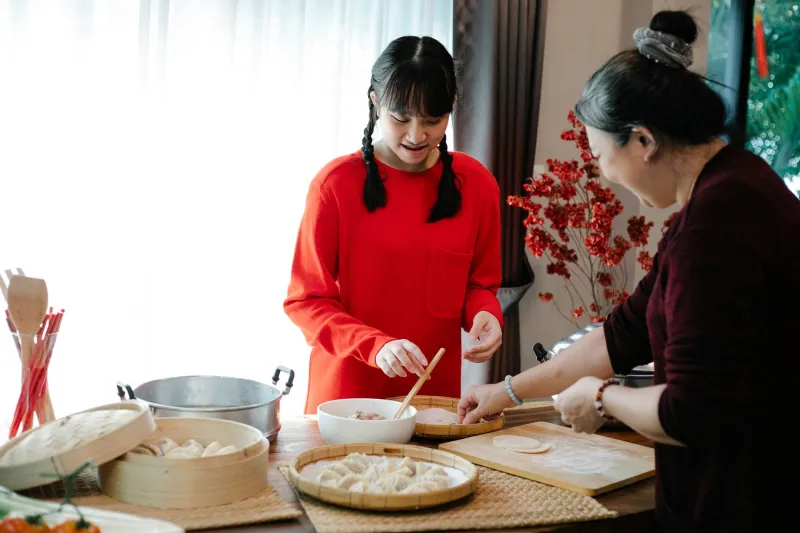
Denise has started cooking with her daughter on Sunday afternoons. She doesn't use recipes. She narrates as she goes — explaining why she's adding the pepper now, what the onions should smell like before the tomatoes go in, how the rice should look when it's almost done. Her daughter is eight.
"She's not going to remember every word I say," Denise says. "But she'll remember the smell. She'll remember standing next to me. And one day, when I'm gone, she'll cook from that memory. And it'll be hers and mine at the same time."
That's how it's always worked, really. The kitchen has always been one of the places where culture breathes — not in a museum behind glass, but in real time, in real heat, with flour on your hands and something good bubbling on the stove. The recipe was never just the recipe. It was everything around it.
And you can't write that down.