Home as Gallery: The Americans Turning Their Living Rooms Into Personal Museums
When Delia Fontaine moved into her Chicago two-flat three years ago, she did what a lot of people do: she scrolled Pinterest. She looked at the serene, sun-drenched interiors. The neutral palettes. The single ceramic bowl on an otherwise empty shelf. She tried, genuinely, to make her space look like that.
It lasted about six weeks.
"I kept walking into my own living room and feeling nothing," she says. "Like I was staying in a hotel. A very beige hotel."
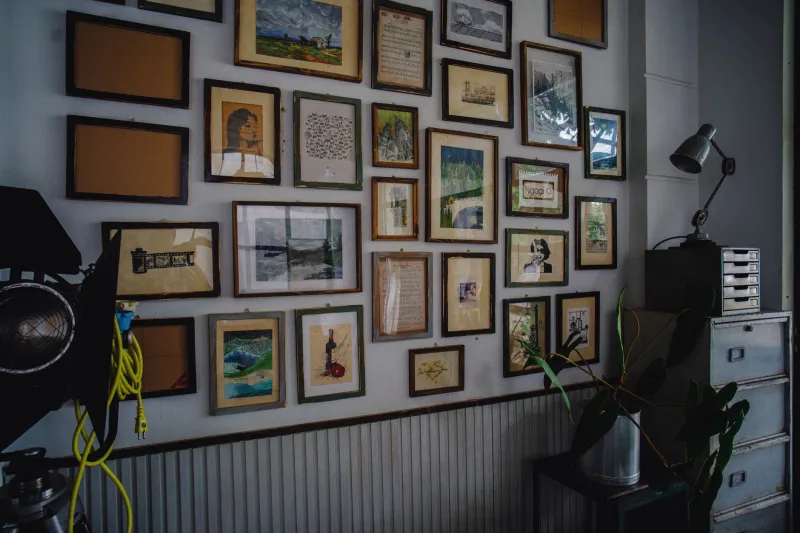
So she started over. Up went the oil painting she'd found at a Milwaukee estate sale — a large, slightly unsettling portrait of a woman in a red hat. Next to it, a framed page from a 1967 National Geographic. Then a shelf of ceramic figurines she'd collected since childhood. Then a textile from a trip to New Mexico. Then more. And more.
"Now I walk in and I feel like me," she says. "Every single thing in there has a story."
The Minimalism Hangover
For roughly a decade, minimalism ruled American interior design discourse. Marie Kondo became a household name. "Does it spark joy?" became both a genuine lifestyle question and an easy punchline. Influencer homes looked identical — white walls, clean lines, houseplants arranged with mathematical precision. The aesthetic was aspirational in a specific way: it signaled control, calm, a life uncluttered by the chaos of actually living.
But something shifted. Maybe it was the pandemic, when people were suddenly trapped inside spaces that needed to do more emotional work. Maybe it was a broader cultural fatigue with sameness. Maybe people just got bored.
Whatever the cause, maximalism is back — and it's brought something more interesting with it than just more stuff. The people leading this shift aren't just piling things up. They're curating. They're thinking about story, meaning, and the relationship between objects. They're, in a very real sense, becoming their own museum directors.
The Language of Curation
The word "curation" gets overused online to the point of meaninglessness, but in this context it actually earns its keep. There's a genuine difference between a crowded room and an intentional one, and the people doing this well understand that distinction intuitively.
Marcos Delgado, a graphic designer in Los Angeles, describes his apartment as "organized chaos with a logic only I fully understand." His walls are covered in a mix of original art from emerging local painters, vintage concert posters, and a rotating series of framed family photographs. His shelves hold books arranged by color, ceramic pieces he's made himself, and objects gathered from flea markets across California.
"I think about sightlines," he says. "I think about what's next to what and why. There's a Basquiat print next to a photo of my grandfather because they're both talking about the same thing to me — identity, survival, joy. Most people who come over don't know that. But I know it."
That private logic — the invisible narrative thread running through a collection — is central to what makes these spaces feel different from mere decoration. They're autobiographical. They're archives. They're, in the most genuine sense, personal.
Thrift, Vintage, and the Ethics of the Find
A significant portion of the objects filling these homes come from secondhand sources — estate sales, thrift stores, antique markets, flea markets, and online platforms like Chairish or Facebook Marketplace. This isn't just budget-consciousness (though it's that too). It's a value system.
"There's something about an object that has already lived a life," says Fontaine. "That portrait I found — I don't know who that woman was. But she was important enough to someone that they commissioned a painting of her. Now she lives in my house. I think about her."
The thrift-and-vintage orientation also quietly pushes back against fast furniture culture — the IKEA-and-done approach that prioritizes cheapness and convenience over meaning. When you spend three Saturdays looking for exactly the right lamp, you develop a relationship with that lamp. It means something.
For many collectors, the hunt is as important as the find. Deja Williams, who lives in Atlanta and describes her home as "Southern gothic maximalism," spends most weekend mornings at estate sales. "People think I'm shopping," she says. "I'm actually doing research. Every object tells you something about how people lived, what they valued, what they kept."
Supporting Living Artists
Alongside vintage finds, many home curators are making intentional choices to include work by living, often emerging, artists — and that economic choice matters.
Platforms like Saatchi Art, Artsy, and a growing number of artist-direct Instagram shops have made it easier than ever to buy original work without a gallery budget. A small oil painting from an emerging artist might run $150 to $400 — not nothing, but accessible in a way that the traditional art market never was.
"I have six original pieces in my apartment," says Delgado. "I know every single one of those artists. I follow their careers. A couple of them I've become friends with. That's a relationship the art market used to gatekeep."
This direct-to-collector dynamic is changing how emerging artists build audiences, and it's changing how collectors think about their role. Buying a piece of original art isn't just decorating anymore — it's participation in a cultural ecosystem.
Telling the Story Out Loud
Something interesting happens when people build these spaces: they become storytellers. Guests ask about objects. Conversations start. Histories get passed down.
Williams hosts what she calls "house tours" for friends — not formal events, just meandering walks through her rooms where she explains the origin of each piece. "My grandmother's quilt is framed on the wall next to a print I bought from a Black woman artist in Brooklyn," she says. "When I explain that juxtaposition to someone, I'm telling them who I am. I'm telling them about my family. I'm telling them what I believe about art and tradition."
That kind of storytelling is, at its core, what museums have always been for. The difference is that these are deeply personal collections — not about cultural history in the abstract, but about one specific human life and everything that shaped it.
The Room That Talks Back
Delia Fontaine's living room has evolved constantly since that first estate sale portrait went up. She's moved things, replaced things, added things. It's never finished.
"I think that's the point," she says. "I'm not finished either."
That's what separates a curated home from a decorated one. Decoration is a destination. Curation is a practice — ongoing, responsive, alive. The room isn't a backdrop for your life. It is your life, made visible and arranged with love.
In an era of infinite digital content and algorithmically flattened aesthetics, that feels quietly revolutionary. You walk in. The walls know you. And everything there has something to say.