Glue Sticks and Good Light: The Americans Falling Back in Love With Physical Photo Albums
Somewhere between the ten-thousandth photo on your camera roll and the moment you realized you hadn't printed a single image in three years, something shifted. For a growing number of Americans, that shift led them to a craft store, a pair of scissors, and a blank album waiting to be filled.
The scrapbook — that decidedly analog, gloriously imperfect art form — is having a full-on moment. And not in a nostalgic, ironic way. People are doing this seriously, intentionally, and with a level of care that the endless scroll of a photo app simply cannot compete with.
Too Many Photos, Not Enough Memory
Here's the strange paradox of modern life: we take more photos than any generation in human history, and yet somehow feel like we're remembering less. The average American smartphone holds thousands of images — birthdays blurred with beach trips, mundane Tuesday lunches filed right next to wedding days. Everything is captured. Almost nothing is curated.
That's the problem Destiny Okafor, a 29-year-old graphic designer from Atlanta, ran into a couple of years ago. "I had over 14,000 photos on my phone and I never looked at any of them," she says. "It was like having a library where every book was the same size and color. You couldn't find anything that mattered."
So she started printing. Small batches at first — a few dozen from a road trip, a handful from her sister's baby shower. Then she bought an album. Then she bought washi tape. Then, almost without realizing it, she had a ritual.
"It's not about making something pretty," Destiny says. "It's about deciding what's worth keeping. And that decision is the whole point."
The Edit Is the Art
There's a reason photographers talk about "the edit" like it's sacred work. Choosing what stays and what goes is where meaning gets made. When your photo app auto-generates a "memory" reel set to soft piano music, it's doing that work for you — and doing it badly, because it doesn't know what actually mattered about that afternoon.
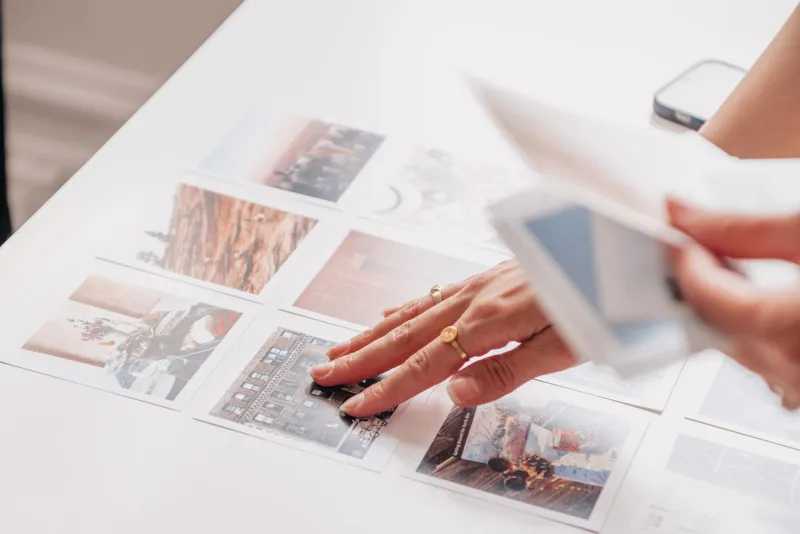
Physical photo curation forces you to be the editor of your own life. You're holding a stack of prints, and you have to decide: which three photos from that camping trip tell the real story? What goes on the left page versus the right? Does that slightly blurry shot of your dad laughing make the cut because it's the most alive he looked all year?
These are not small decisions. They are, in fact, the work of personal storytelling — and people are hungry to do it themselves.
Marcos Reyes, a high school history teacher in Phoenix, started scrapbooking after his grandmother passed away and left behind two handmade albums from the 1970s. "The photos weren't even great quality," he says. "But the fact that she had chosen them — written little notes in the margins, put ticket stubs next to pictures from the same night — it made the whole thing feel like a conversation with her. I wanted to make something like that for my own kids someday."
A Counter-Cultural Act That Doesn't Try to Be
What's interesting about the scrapbooking revival is that it's not particularly loud about itself. You won't find it trending with a manifesto. It's not a protest. It's more like a quiet exhale — a personal decision to opt out of the infinite archive and into something bounded, physical, and yours.
Craft stores like Michaels and JOANN have reported steady upticks in scrapbooking supply sales over the past few years, particularly among the 25-40 demographic — a group that grew up digital but carries a distinct nostalgia for tangible things. Meanwhile, communities on Reddit and niche corners of Instagram (yes, the irony is noted) have become gathering places for people sharing album spreads, trading tips on archival-safe adhesives, and debating the merits of 4x6 versus 5x7 prints.
But the practice itself almost always happens offline, alone or with a friend at a kitchen table with music on and nowhere else to be.
"It's one of the only things I do that doesn't involve a screen," says Jordan Whitfield, a nurse from Nashville who scrapbooks on Sunday afternoons. "My phone is literally across the room. I'm cutting things with scissors. It feels so old-fashioned and I love it completely."
Memory as Material
There's something worth sitting with here: when you print a photo and place it in an album, you are making a physical claim that this moment existed and mattered. The photo occupies space. It has weight. It can yellow at the edges and get a coffee ring on the corner and still outlast every app update, every platform shutdown, every time a tech company decides your storage plan costs more now.
That durability isn't just practical — it's emotional. People who scrapbook often describe the albums they've made as objects they'd grab in an emergency. Not their laptops. Not their external hard drives. The album.
Destiny keeps hers on a low shelf in her living room where guests can actually reach them. "People always pick them up," she says. "Nobody scrolls through someone else's camera roll at a dinner party. But they will absolutely sit on your couch and look through a photo album for an hour."
That's the thing about physical objects — they invite people in. They start conversations. They are, in the most literal sense, something to hold onto.
Starting Without Overthinking It
If there's a barrier to entry here, it's the myth of perfection. Scrapbooking has a reputation — rightly or wrongly — for elaborate layouts, color-coded sticker collections, and a level of craftiness that not everyone feels they possess. But the people actually doing it tend to push back hard on that image.
"You don't need to be artistic," Marcos insists. "You just need to print some photos and put them somewhere they won't disappear. The rest is just playing around."
The tools are genuinely simple: a photo printing app or a local drugstore, an album or a blank journal, some tape or glue, and maybe a pen for dates and captions. The rest is instinct.
And maybe that's the most radical part of all this — the idea that you don't need a platform, an algorithm, or an AI to tell you which moments from your life deserve to be remembered. You already know. You just need somewhere to put them.
The scrapbook, it turns out, is that somewhere. And a lot of Americans are finally finding their way back to it.