Touch, Feel, Rewind: The Young Americans Choosing Analog Over Algorithms
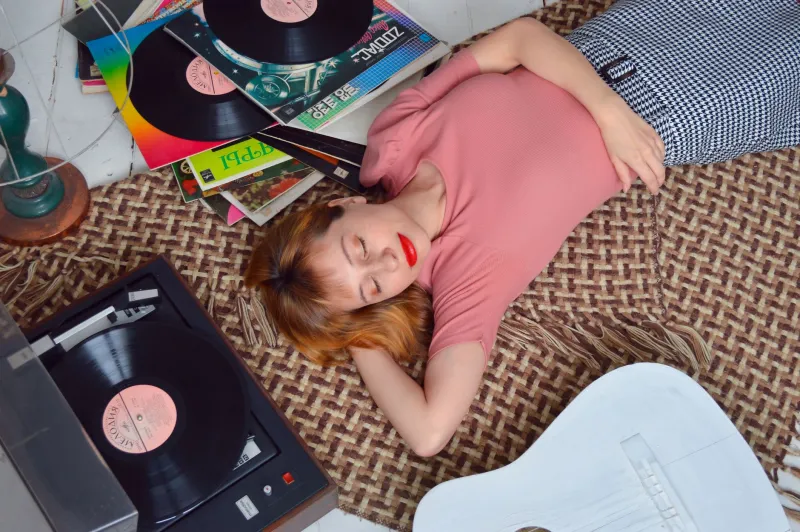
There's a record player sitting on a thrifted dresser in Maya Okonkwo's Chicago apartment, and it is, she'll tell you without a hint of irony, the most important piece of technology she owns. Not her MacBook. Not her iPhone. The turntable.
"When I put on a record, I have to be present," says the 27-year-old graphic designer, who started collecting vinyl during the pandemic and hasn't really stopped. "I can't skip. I can't shuffle. I have to actually sit with the music."
Maya isn't alone. Across the US, a quiet but unmistakable cultural current is pulling young people away from the frictionless convenience of digital media and back toward things you can hold, smell, and wear out with use. Vinyl sales hit their highest numbers since the 1980s in 2023. Film photography is booming, with brands like Kodak ramping up production to meet demand. And zine culture — those scrappy, photocopied, hand-assembled publications that punk kids were making in the '70s and '80s — is having what can only be described as a full-on moment.
So what's actually going on here?
The Exhaustion of Everything Being Everywhere
Let's be honest: the digital landscape is a lot. Streaming platforms offer tens of millions of songs, and somehow that abundance makes choosing what to listen to feel like a chore. Instagram feeds refresh endlessly. Spotify's algorithm knows your taste better than you do, which is either comforting or deeply unsettling depending on your mood.
For many young Americans, the appeal of analog isn't really about the past — it's about reclaiming the experience of choosing. When you buy a record, you're making a commitment. When you load a roll of 35mm film, you've got 36 shots, and that's it. There's a built-in intentionality that digital media has essentially engineered away.
"Digital removed all the friction, and for a while that felt like pure freedom," says cultural critic and podcast host Darnell Price, based in Atlanta. "But friction is also where meaning lives. When everything is effortless and infinite, nothing feels particularly significant."
This idea — that constraints can actually be generative — is central to understanding why analog is resonating so hard right now.
The Vinyl Revival Isn't Just Vibes
Record Store Day, the annual celebration of independent music retail, drew its largest crowds ever in 2024. Shops like Amoeba in LA, Reckless Records in Chicago, and Academy Records in New York report that a significant portion of their customer base is under 35 — people who grew up with iTunes and Spotify, not cassette tapes and CD towers.
For many of them, vinyl is less about audio fidelity (though audiophiles will absolutely go there with you) and more about ritual. The act of pulling a record from its sleeve, placing it on the platter, and dropping the needle creates a kind of ceremony around listening. You're not multitasking. You're not doom-scrolling with music in the background. You're listening.
Jordan Fisk, a 24-year-old in Portland who runs a small vinyl trading community on Discord, puts it simply: "A record demands your attention in a way a Spotify playlist never will. And honestly? That feels like a gift."
There's also something to be said for the physical object itself — the album art, the liner notes, the weight of it in your hands. In an era of invisible files and cloud storage, owning something tangible carries a different kind of meaning.
Film Photography and the Joy of Not Knowing
Walk through any arts district in Brooklyn, Austin, or Silver Lake on a weekend and you'll spot them: young people with point-and-shoot film cameras hanging around their necks like talismans. Disposable cameras are back on the shelves at Urban Outfitters. Darkroom workshops in cities across the country are booked out weeks in advance.
Film photography's appeal operates on a different axis than vinyl, but the underlying impulse is similar. You can't immediately review what you shot. You can't delete the blurry one. You won't see the results for days, maybe weeks, depending on your lab turnaround. And that delayed gratification — so utterly at odds with the instant-everything culture of social media — turns out to be deeply satisfying.
"There's this anticipation when you drop off a roll," says Priya Mehta, a 29-year-old photographer in Philadelphia who shoots exclusively on film. "And when you finally get the scans back, you actually remember taking those pictures. They mean something because they cost something — in time, in money, in attention."
Film images also look different, and not just technically. They carry evidence of their own making — grain, light leaks, slight imperfections — that feels more honest than the hyper-processed aesthetic of smartphone photography. In a visual culture saturated with filters designed to simulate imperfection, the real thing hits differently.
Zines: The Original Independent Media
If vinyl and film feel like rediscoveries, zines feel like a genuine revelation for a generation that never really knew them the first time around. These self-published, often hand-assembled mini-publications — covering everything from personal essays to poetry to political manifestos to niche fandoms — are showing up at craft fairs, independent bookshops, and zine fests in cities nationwide.
The Brooklyn Zine Fest, the Chicago Zine Fest, and the LA Zine Fest all reported record attendance in recent years. And the content being produced is wildly varied: queer personal narratives, radical environmental politics, hyper-local neighborhood histories, absurdist humor, grief journals, food writing. The format is gloriously democratic — all you need is access to a photocopier and something to say.
"Zines are the anti-algorithm," says Tomás Rivera, who publishes a bilingual zine about Latinx creative culture out of San Antonio. "Nobody's optimizing for engagement. Nobody's chasing clicks. You make it because you need to make it, and you give it to people who actually want it."
That directness — creator to reader, no platform in between — is exactly what makes zines feel so radical right now.
What This All Actually Means
It would be easy to dismiss all of this as aesthetic trend-chasing, and sure, some of it probably is. But there's a more interesting story underneath the surface-level cool.
These analog practices share a common thread: they require presence. They resist multitasking. They create objects and experiences that exist outside of any platform's ecosystem. They generate community — record swap meets, film photography clubs, zine fests — in physical space, among actual humans.
In a cultural moment defined by algorithmic mediation, surveillance capitalism, and the slow creep of AI-generated everything, choosing analog is a small but meaningful act of self-determination. It's saying: I want to decide what I consume, how I create, and what I keep.
Maya Okonkwo, back in her Chicago apartment, puts it in the most straightforward terms possible.
"My phone is always trying to tell me what to do next," she says, lifting the needle from the end of a side. "My record player just plays music. That's enough. That's actually everything."
She flips the record. The needle drops. The room fills with sound.